

If you own a home in Ireland, you could be leaving thousands of euros on the table. The Irish government, through SEAI and local authorities, offers a wide range of home improvement grants designed to reduce energy bills, modernise older homes, and bring vacant properties back to life. This guide covers every grant available in 2026, who qualifies, how much you can get, and exactly how to apply.
What Are Home Improvement Grants in Ireland?
Home improvement grants in Ireland are government-funded payments that help homeowners, landlords, and buyers reduce the cost of renovating or upgrading a property. They are not loans; you do not pay them back.
Most grants are managed by the Sustainable Energy Authority of Ireland (SEAI), which focuses on energy-efficiency upgrades such as insulation, heat pumps, and solar panels. Local authorities also administer separate schemes for vacant properties, housing adaptations, and social housing improvements.
The core purpose is two-fold: to cut household energy costs and to improve Ireland’s housing stock. With rising energy prices and a national housing shortage, these grants have become more generous and more accessible than ever. Many homeowners combine multiple grants in a single renovation project to maximise funding.
What Home Improvement Grants Are Available in Ireland? (Full List)
Here is a full breakdown of every major home renovation grant currently available in Ireland.
SEAI Home Energy Grants
The SEAI Home Energy Grant scheme is the umbrella programme covering most energy-related upgrades. Homeowners can apply for individual measures, such as insulation, heating systems, solar panels or combine them under one application. An SEAI-registered contractor must carry out works.
Vacant Property Refurbishment Grant
This grant provides up to €50,000 for refurbishing a vacant property and up to €70,000 for a derelict one. Introduced to tackle Ireland’s housing shortage, it is available to buyers and owners of properties that have been empty for at least two years. The property must be used as your primary residence after renovation.
Better Energy Homes Scheme
The Better Energy Homes scheme gives fixed grants for individual energy upgrades — attic insulation, wall insulation, heat pumps, solar thermal, and more. It suits homeowners who want to upgrade one or two measures without committing to a deep retrofit. Applications are made directly through the SEAI portal.
Deep Retrofit Grants
Deep retrofit grants provide up to €50,000 (or up to 50% of costs) to transform a home into a near-zero energy building (NZEB). The scheme targets homes with a BER of D or lower. It covers a comprehensive package of upgrades, insulation, air tightness, heat pumps, and ventilation, all delivered under a single contract.
Solar Panel (PV) Grants
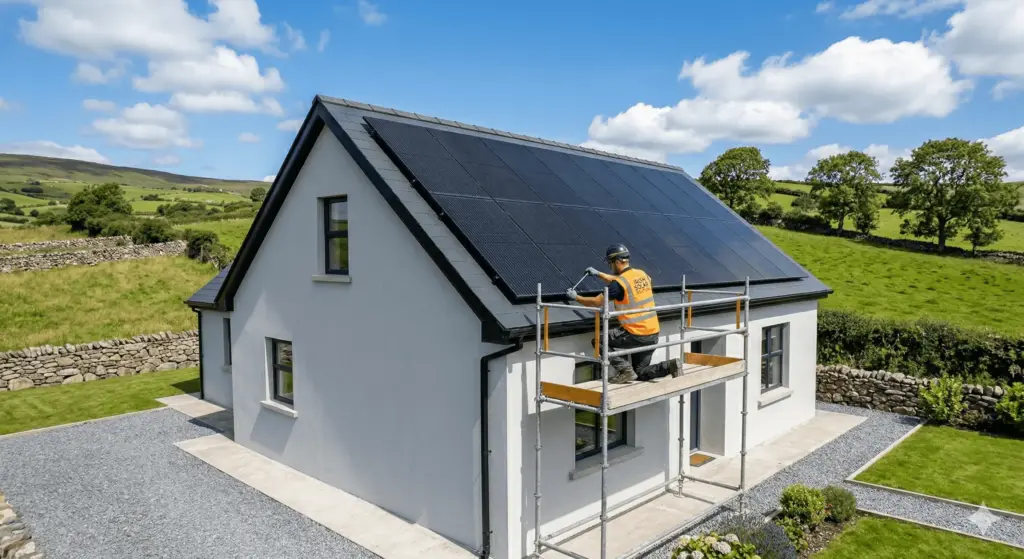
SEAI offers grants of up to €2,400 for solar photovoltaic (PV) panel installation. This covers panels up to 4kWp in size. Homeowners can also avail of the Microgeneration Support Scheme, which pays you for excess electricity exported to the grid.
Insulation Grants
Insulation grants cover attic, cavity wall, and internal/external dry lining insulation. Grant amounts vary by measure and home type. Insulation is one of the most cost-effective upgrades available and is often the first step before applying for a heat pump grant.
Window & Door Upgrade Grants
Grants are available for upgrading windows and external doors as part of a broader retrofit project. These upgrades must meet minimum performance standards. They are typically combined with insulation or heating upgrades to maximise energy savings.
Traditional Farm Buildings Grant
The Traditional Farm Buildings Grant, managed by the Heritage Council, helps conserve historic farmyard structures using traditional materials and methods. Grant rates of up to 80% apply in certain cases. It is aimed at farmers and landowners maintaining protected or vernacular buildings.
Discuss Your Project with Us
Housing Adaptation Grant for Older People
This grant, administered by local authorities, provides up to €30,000 to adapt a home for an older person or a person with a disability. It covers ramps, stairlifts, wet rooms, and other accessibility works. Eligibility is means-tested, and priority is given to those with the greatest need.
Summary Table
| Grant Name | Max Amount | Purpose | Managed By |
| SEAI Home Energy Grants | Varies by measure | Energy efficiency upgrades | SEAI |
| Vacant Property Refurbishment | €70,000 | Refurbish empty/derelict homes | Dept. of Housing / Local Authorities |
| Better Energy Homes | Varies | Individual energy measures | SEAI |
| Deep Retrofit | €50,000 | Full home energy transformation | SEAI |
| Solar PV Grant | €2,400 | Solar panel installation | SEAI |
| Insulation Grants | Varies | Attic, wall, dry lining insulation | SEAI |
| Window & Door Grant | Varies | High-performance windows/doors | SEAI |
| Traditional Farm Buildings | Up to 80% of costs | Heritage farm building conservation | Heritage Council |
| Housing Adaptation Grant | €30,000 | Accessibility for older/disabled | Local Authorities |
Home Improvement Grants Ireland (Comparison Table)
Understanding which grant suits your situation is key to getting the most from available funding.
| Grant Name | Max Funding | Eligibility | Best For |
| Deep Retrofit | €50,000 | BER D or lower, built before 2011 | Older homes needing full upgrade |
| Vacant Property Refurbishment | €70,000 | Property vacant 2+ years | Buyers of derelict/empty homes |
| Better Energy Homes | Varies | Homeowners, landlords | Single energy measure upgrades |
| Solar PV | €2,400 | Any homeowner | Reducing electricity bills |
| Insulation Grants | Up to €8,000+ | Homeowners, landlords | Cold, poorly insulated homes |
| Housing Adaptation Grant | €30,000 | Older people, means-tested | Mobility or disability adaptations |
| Traditional Farm Buildings | 80% of works | Farm/heritage property owners | Conservation of historic structures |
Key takeaway:
Most homeowners will benefit most from the SEAI suite of grants, particularly the deep retrofit or Better Energy Homes schemes, depending on the scale of their project. The Vacant Property Grant is the standout option for anyone buying an empty or derelict property.
Who Is Eligible for Home Renovation Grants in Ireland?
Eligibility varies by scheme, but here are the general rules for the most popular grants:
Homeowners
- Must own and live in the property as your primary residence
- Home must be built and occupied before a certain date (varies by scheme — typically before 2011 for SEAI energy grants)
- Must use an SEAI-registered contractor for energy works
Landlords
- Landlords can apply for SEAI Better Energy grants for rental properties
- Properties must be registered with the Residential Tenancies Board (RTB)
- Specific grants, like the deep retrofit, have additional landlord eligibility rules
Vacant Property Buyers
- The Vacant Property Refurbishment Grant is open to buyers, not just existing homeowners
- The property must have been vacant for at least two years
- It must become your primary residence or be made available for rent
Income-Based Grants
- Some schemes, like the Warmer Homes Scheme, are reserved for homeowners on social welfare payments or low incomes
- The Housing Adaptation Grant is means-tested by your local authority
BER Requirements
- A BER is carried out by a registered assessor and costs approximately €150–€250
- Several SEAI grants require a home to have a BER (Building Energy Rating) assessment before and after works
How to Apply for Home Improvement Grants (Step-by-Step Guide)
Applying for home renovation grants in Ireland is straightforward if you follow the correct process. Here is exactly what to do.
Step 1: Check Your Eligibility:- Before anything else, confirm your property and personal circumstances meet the grant requirements. Visit seai.ie for energy grants or your local authority website for adaptation and vacant property grants.
Step 2: Choose the Right Grant (or Grants):- Identify which grants apply to your project. Many homeowners combine the deep retrofit grant with a solar PV grant, for example. Make a list of everything you want to upgrade.
Step 3: Hire a Registered Contractor:- For SEAI grants, all works must be completed by an SEAI-registered contractor. Hiring someone who is not registered will disqualify your application. Search the SEAI contractor database online before getting quotes.
Step 4: Submit Your Application:- Apply online through the SEAI portal (for energy grants) or directly to your local authority (for adaptation or vacant property grants). You will need proof of ownership, a recent BER, and your contractor’s details.
Step 5: Wait for Approval:- Do not start any work before receiving written approval from SEAI or your local authority. Starting early is one of the most common mistakes and will result in your grant being refused.
Step 6: Complete the Works and Claim Your Grant:- Once the works are finished, your contractor submits the completion documents. SEAI inspects a percentage of completed works. Payment is typically made within 4–8 weeks of approval.

How Much Can You Get? (Grant Amount Breakdown)
Insulation Grant Amounts
Insulation grants vary depending on the type of insulation and the size of the property.
| Insulation Type | Grant Amount (up to) |
|---|---|
| Attic Insulation | €1,500 |
| Cavity Wall Insulation | €1,700 |
| Internal Dry Lining (per dwelling) | €4,500 |
| External Wall Insulation | €8,000 |
These amounts apply to standard detached homes. Apartments and smaller homes may receive lower amounts. Combining insulation types can significantly increase your total grant.
Solar Panel Grant Amounts
| System Size | Grant Amount |
|---|---|
| Up to 2kWp | €900 |
| 2kWp to 4kWp | €1,800 |
| Battery storage (additional) | €600 |
| Maximum (panels + battery) | €2,400 |
Solar grants are paid as a flat rate per kilowatt-peak (kWp) installed. The average Irish home installs a 3–4kWp system, qualifying for the full €2,400.
Deep Retrofit Grant Funding
The deep retrofit grant is the most generous single package available.
| Funding Element | Amount |
|---|---|
| Maximum grant | €50,000 |
| Maximum % of eligible costs | 50% |
| Additional support (low income) | Up to 80% |
| Average project cost (typical home) | €40,000–€75,000 |
Low-income households may qualify for higher funding percentages under the National Home Energy Upgrade Scheme.
Deep Retrofit Grants Ireland (Complete Guide)
Deep retrofit means upgrading a home comprehensively so it reaches a BER of B2 or better — the standard for a near-zero energy building. It goes far beyond a single insulation job.
Who Qualifies?
- Homeowners whose property has a BER of D or lower
- Built and occupied before 2011
- Must use an SEAI-registered One Stop Shop (OSS) provider who manages the full project
What’s Included? A deep retrofit typically covers: external wall insulation, attic and floor insulation, air tightness measures, a heat pump, mechanical ventilation with heat recovery (MVHR), and sometimes solar PV.
Funding Available Up to €50,000 or 50% of eligible costs — whichever is lower. Low-income households can receive up to 80% funding.
Benefits: Homeowners who complete a deep retrofit typically see energy bill savings of €1,000–€2,500 per year. The BER improvement also adds significant resale value. Ireland has a national target to retrofit 500,000 homes by 2030, meaning funding is actively supported at the government level.

SEAI Grants Ireland Explained
SEAI — the Sustainable Energy Authority of Ireland — is the national body responsible for promoting and funding energy efficiency in Irish homes and businesses.
Established under the Sustainable Energy Act 2002, SEAI manages the bulk of home improvement grant funding available to Irish homeowners. Every year, they distribute hundreds of millions of euros in grants through schemes like Better Energy Homes, the Deep Retrofit programme, and the Warmer Homes Scheme.
Why SEAI Matters
- All SEAI grants require registered contractors, ensuring quality and accountability
- SEAI inspects completed works to verify that standards are met
- They provide free advice and online tools to help homeowners navigate the system
How to Contact SEAI: Apply and manage grants through seai.ie. Their helpline (01 808 2100) is available for direct queries. Most applications are processed entirely online.
SEAI grants are non-repayable and stackable — meaning you can combine multiple grants in a single renovation project, dramatically reducing your out-of-pocket costs.
Best Grants for Home Renovation in Ireland
Not sure where to start? Here are the best grants depending on your situation.
For Low-Budget Renovations:-
The Better Energy Homes scheme is ideal if you only have the budget for one or two upgrades. Start with attic insulation — it is cheap, fast, and one of the highest-return investments for heat retention.
For Maximum Energy Savings:-
The Deep Retrofit Grant delivers the biggest long-term energy savings. Yes, the upfront costs are higher, but with up to €50,000 in funding and annual savings of €1,500+, the payback period is typically 7–12 years.
For Old or Derelict Homes:-
Combine the Vacant Property Refurbishment Grant (up to €70,000) with SEAI energy grants for the most comprehensive package. This combination is ideal for anyone buying and restoring a period property.
For Solar and Self-Sufficiency:-
The Solar PV Grant (up to €2,400), combined with a battery storage top-up and the Microgeneration Support Scheme, gives the best return if you want to reduce dependence on the grid.
Common Mistakes to Avoid When Applying
Even well-prepared applicants make avoidable errors. Here is what to watch out for:
- Hiring the Wrong Contractor
Only SEAI-registered contractors are eligible for energy grants. Hiring an unregistered tradesperson — even a highly skilled one — means you will not qualify. Always verify registration before signing any contract.
2. Starting Works Before Approval
This is the most costly mistake. SEAI and local authorities will not fund works that have already started. Wait for written approval before lifting a shovel.
3. Missing Documents
Common documentation gaps include a missing or outdated BER certificate, proof of ownership, or incomplete contractor details. Have everything ready before submitting to avoid delays.
4. Applying for the Wrong Scheme
Some homeowners apply for Better Energy Homes when they would benefit more from the Deep Retrofit, or vice versa. Take time to compare schemes before committing.
5. Not Combining Grants
Many homeowners leave money behind by applying for just one grant when they could combine several. A single application can often cover insulation, a heat pump, and solar PV — significantly increasing total funding.
Discuss Your Project with Us
FAQs
What grants are available for home improvements in Ireland?
Ireland offers a wide range of grants, including SEAI energy grants (insulation, heat pumps, solar PV), the Vacant Property Refurbishment Grant (up to €70,000), the Deep Retrofit Grant (up to €50,000), the Housing Adaptation Grant (up to €30,000), and the Better Energy Homes scheme for individual upgrades.
How much is the home renovation grant in Ireland?
It depends on the scheme. The Vacant Property Refurbishment Grant goes up to €70,000 for derelict homes. The Deep Retrofit Grant covers up to €50,000. Individual SEAI grants range from €600 (battery storage top-up) to €8,000 (external wall insulation). Most homeowners who combine grants can access €15,000–€40,000 in total funding.
Can I apply for multiple grants at the same time?
Yes — in many cases, you can combine SEAI grants with each other, and also apply for the Vacant Property Refurbishment Grant separately. Some restrictions apply, so check the terms of each scheme before submitting.
Do I need a BER rating to apply?
For most SEAI energy grants, yes. A BER certificate is required before works begin. Your registered contractor or One Stop Shop provider can usually arrange this as part of the project.
How long does approval take?
SEAI applications for individual measures (Better Energy Homes) typically take 4–8 weeks. Deep retrofit applications through a One Stop Shop can take longer due to the complexity of the project. Vacant Property and Housing Adaptation grants vary by local authority but generally take 6–12 weeks.
Conclusion
Ireland’s home improvement grant landscape in 2026 is more generous than ever. Whether you are insulating a cold terrace, retrofitting a 1970s semi-detached, bringing a vacant cottage back to life, or adding solar panels to cut bills, there is a grant — often several — designed to help you do it.
The key is knowing what is available, checking your eligibility carefully, and hiring the right registered contractors. Do not leave thousands of euros unclaimed.
Take action today: visit seai.ie to check your eligibility, or contact your local authority about the Vacant Property Refurbishment or Housing Adaptation Grant. The funding is there — you just need to apply for it.

At ConneallyGroup.com, our editorial content is developed by experienced professionals in construction, engineering, and infrastructure services. We aim to provide valuable guidance, helpful resources, and industry insights that support clients and stakeholders at every stage — from planning and design to execution and completion. Our focus is on clarity, integrity, and practical solutions you can trust.